
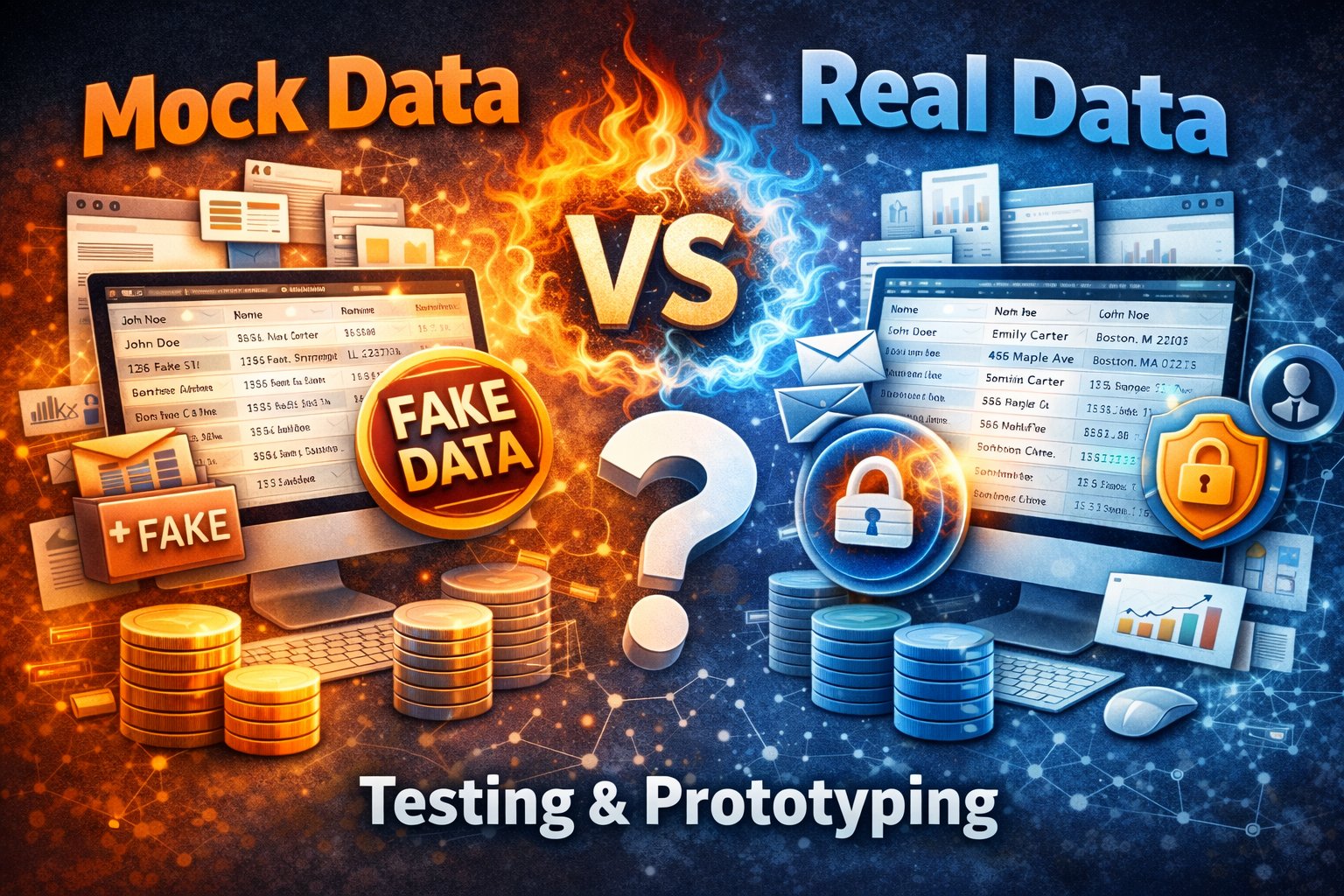
In the world of software development, one of the most common dilemmas developers face is deciding between mock data and real data for testing and prototyping. This decision can significantly impact development speed, security, compliance, and the overall quality of your application.
Whether you're building a new feature, testing an API, or creating a prototype for stakeholders, understanding when to use synthetic data versus production data is crucial for successful project outcomes. In this comprehensive guide, we'll explore the key differences, benefits, and practical scenarios where each approach excels.
Understanding Mock Data vs Real Data
What is Mock Data?
Mock data, also known as synthetic data or fake data, is artificially generated information that mimics the structure and characteristics of real data without containing actual sensitive information. It's created using algorithms, patterns, or tools specifically designed to produce realistic-looking datasets for development purposes.
Examples of mock data include:
- Generated user profiles with fake names, emails, and addresses
- Synthetic transaction records with realistic amounts and dates
- Artificial product catalogs with sample descriptions and prices
- Simulated sensor data with appropriate ranges and patterns
What is Real Data?
Real data refers to actual information collected from production systems, user interactions, or live environments. This data contains genuine patterns, edge cases, and complexities that exist in real-world scenarios.
Examples of real data include:
- Actual customer records from your CRM system
- Historical transaction data from payment processors
- Real user behavior analytics from your website
- Genuine sensor readings from IoT devices
The Case for Mock Data: When Synthetic Data Shines
1. Early Development and Prototyping
During the initial stages of development, mock data is invaluable for getting projects off the ground quickly. When you're building new features or creating prototypes, you often don't have access to real data yet, or the systems that generate real data aren't ready.
Use mock data when:
- Building MVP (Minimum Viable Product) versions
- Creating proof-of-concept demonstrations
- Developing new features before integration with live systems
- Testing UI/UX designs with realistic-looking content
Our Mock Data Generator excels in these scenarios, allowing you to quickly create realistic datasets that match your application's requirements without waiting for real data sources.
2. Privacy and Compliance Requirements
In today's regulatory environment, using real data for testing can create significant compliance risks. Regulations like GDPR, HIPAA, and CCPA impose strict requirements on how personal data is handled, stored, and processed.
Mock data advantages for compliance:
- No Personal Information: Eliminates risk of exposing sensitive customer data
- Regulatory Compliance: Meets privacy requirements without complex anonymization
- Reduced Liability: Minimizes legal risks associated with data breaches
- Simplified Processes: No need for data masking or anonymization procedures
3. Scalable Testing Scenarios
Mock data allows you to create specific testing scenarios that might be difficult or impossible to replicate with real data. You can generate edge cases, stress test scenarios, and specific data patterns on demand.
Testing scenarios where mock data excels:
- Volume Testing: Generate millions of records to test performance
- Edge Case Testing: Create specific data patterns that trigger unusual behaviors
- Boundary Testing: Generate data at the limits of acceptable ranges
- Error Condition Testing: Create malformed or problematic data intentionally
4. Development Environment Isolation
Using mock data helps maintain clean separation between development, testing, and production environments. This isolation prevents accidental data corruption and ensures that development activities don't impact live systems.
Benefits of environment isolation:
- Developers can experiment freely without fear of breaking production data
- Testing environments remain consistent and reproducible
- No risk of accidentally modifying or deleting real customer information
- Simplified environment setup and teardown processes
The Case for Real Data: When Authenticity Matters
1. Performance and Load Testing
While mock data can simulate volume, real data provides authentic patterns, distributions, and complexities that can reveal performance bottlenecks that synthetic data might miss.
Real data advantages for performance testing:
- Authentic Query Patterns: Real data reflects actual usage patterns
- Genuine Data Distribution: Natural clustering and skewing of data
- Realistic Relationships: Complex interdependencies between data elements
- Historical Patterns: Time-based trends and seasonal variations
2. User Acceptance Testing (UAT)
When stakeholders and end-users are testing the system, real data can provide more meaningful and relatable testing experiences. Users can better evaluate functionality when working with familiar, actual data.
UAT scenarios favoring real data:
- Business users testing reports with actual historical data
- Stakeholders reviewing dashboards with real metrics
- End-users validating workflows with familiar records
- Training sessions using actual company data
3. Data Migration and Integration Testing
When migrating systems or integrating with external services, real data is often necessary to validate that the migration process works correctly and that integrations handle actual data formats and edge cases.
Migration scenarios requiring real data:
- Database migration validation
- API integration testing with third-party services
- Data transformation and ETL process validation
- Legacy system replacement verification
Hybrid Approaches: Best of Both Worlds
In many cases, the optimal approach combines both mock and real data strategically throughout the development lifecycle.
The Development Pipeline Strategy
- Early Development: Start with mock data for rapid prototyping
- Feature Development: Use mock data for isolated feature testing
- Integration Testing: Introduce real data for system integration validation
- Performance Testing: Use real data for authentic performance evaluation
- User Acceptance: Provide real data for stakeholder validation
Data Masking and Anonymization
When you need the authenticity of real data but must maintain privacy, consider data masking techniques:
- Pseudonymization: Replace identifiable information with artificial identifiers
- Data Scrambling: Randomize sensitive fields while maintaining data relationships
- Synthetic Data Generation: Create realistic data based on real data patterns
- Subset Creation: Use representative samples of real data with sensitive information removed
Practical Examples: Mock Data in Action
E-commerce Application Testing
Scenario: Testing a new product recommendation engine
Mock Data Approach:
- Generate 10,000 fake customer profiles with varied demographics
- Create 5,000 synthetic product records across different categories
- Simulate purchase history with realistic patterns
- Test recommendation algorithms with controlled data sets
Benefits: Fast iteration, no privacy concerns, ability to test edge cases like new customers or unusual purchase patterns.
Financial Application Development
Scenario: Building a personal finance dashboard
Mock Data Approach:
- Generate realistic transaction data with appropriate amounts and categories
- Create synthetic account balances and investment portfolios
- Simulate various financial scenarios (debt, savings, investments)
- Test budgeting algorithms with controlled spending patterns
Benefits: Compliance with financial regulations, ability to test various financial situations, no risk of exposing sensitive financial information.
Healthcare System Prototyping
Scenario: Developing a patient management system
Mock Data Approach:
- Generate synthetic patient records with realistic medical conditions
- Create fake appointment schedules and treatment histories
- Simulate various patient demographics and medical scenarios
- Test reporting and analytics features with controlled datasets
Benefits: HIPAA compliance, ability to test rare medical scenarios, no risk of patient privacy violations.
How to Generate Effective Mock Data
Key Principles for Quality Mock Data
1. Realistic Patterns:
- Use appropriate data distributions (normal, uniform, skewed)
- Maintain logical relationships between data fields
- Include realistic edge cases and outliers
- Follow domain-specific conventions and formats
2. Appropriate Volume:
- Generate enough data to test performance characteristics
- Include sufficient variety to test different scenarios
- Scale data volume to match expected production loads
- Consider data growth patterns over time
3. Consistent Quality:
- Maintain data integrity and referential consistency
- Use consistent formatting and validation rules
- Include appropriate null values and missing data
- Ensure data freshness and temporal consistency
Using Our Mock Data Generator Tool
Our Mock Data Generator simplifies the process of creating high-quality synthetic data for your projects. Here's how to use it effectively:
- Define Your Schema: Specify the data fields and types you need
- Set Realistic Parameters: Configure data ranges, formats, and patterns
- Generate at Scale: Create the volume of data appropriate for your testing needs
- Export and Integrate: Download your data in formats compatible with your development tools
The tool supports various data types including names, emails, addresses, phone numbers, dates, and custom patterns, making it suitable for a wide range of applications.
Common Pitfalls and How to Avoid Them
Mock Data Pitfalls
1. Oversimplified Data:
- Problem: Mock data that's too clean and doesn't reflect real-world messiness
- Solution: Include realistic variations, edge cases, and data quality issues
2. Unrealistic Relationships:
- Problem: Data fields that don't correlate naturally
- Solution: Ensure logical relationships between related data fields
3. Insufficient Volume:
- Problem: Testing with too little data to reveal performance issues
- Solution: Generate data volumes that match or exceed expected production loads
Real Data Pitfalls
1. Privacy Violations:
- Problem: Using sensitive customer data in non-production environments
- Solution: Implement proper data masking or use synthetic alternatives
2. Data Staleness:
- Problem: Using outdated real data that doesn't reflect current patterns
- Solution: Regularly refresh test datasets or supplement with current mock data
3. Environment Contamination:
- Problem: Accidentally modifying or corrupting production data during testing
- Solution: Use read-only copies or isolated environments for testing
Tools and Technologies for Mock Data Generation
Programming Libraries and Frameworks
Popular Mock Data Libraries:
- Faker (Python/JavaScript/PHP): Comprehensive fake data generation
- Factory Boy (Python): Test fixture replacement for Django
- Chance.js (JavaScript): Random generator helper for JavaScript
- Bogus (.NET): Fake data generator for .NET applications
Database-Specific Tools:
- SQL Data Generator: Microsoft SQL Server data generation
- MySQL Test Data Generator: Specialized MySQL data creation
- PostgreSQL Generate Series: Built-in data generation functions
- MongoDB Faker: Document-based fake data generation
Online Tools and Services
For quick prototyping and smaller datasets, online tools like our Mock Data Generator provide immediate access to synthetic data without requiring setup or programming knowledge.
Advantages of online tools:
- No installation or setup required
- Immediate data generation
- Multiple export formats
- User-friendly interfaces for non-developers
Best Practices for Mock Data Management
Version Control and Documentation
- Document Data Schemas: Maintain clear documentation of your mock data structure
- Version Control Scripts: Keep data generation scripts in version control
- Seed Data Management: Use consistent seed values for reproducible datasets
- Change Tracking: Document changes to mock data schemas and generation logic
Environment Management
- Environment-Specific Data: Tailor mock data to specific testing environments
- Data Refresh Strategies: Implement regular data refresh cycles
- Cleanup Procedures: Establish processes for cleaning up test data
- Access Controls: Implement appropriate access controls even for mock data
Quality Assurance
- Data Validation: Implement checks to ensure mock data quality
- Consistency Testing: Verify that mock data maintains logical consistency
- Performance Monitoring: Monitor the performance impact of mock data generation
- Feedback Loops: Collect feedback from developers and testers on data quality
Future Trends in Mock Data Generation
AI-Powered Synthetic Data
Artificial intelligence is revolutionizing mock data generation by creating more realistic and contextually appropriate synthetic datasets. AI-powered tools can:
- Learn patterns from real data to generate more authentic mock data
- Create complex relationships and dependencies automatically
- Generate domain-specific data with appropriate context
- Adapt to changing data patterns and requirements
Privacy-Preserving Techniques
Advanced techniques like differential privacy and federated learning are enabling new approaches to synthetic data generation that maintain privacy while preserving data utility.
Real-Time Data Generation
Emerging tools can generate mock data in real-time, adapting to application needs dynamically and providing more realistic testing scenarios for modern, event-driven applications.
Making the Right Choice: Decision Framework
Use this decision framework to determine whether mock data or real data is appropriate for your specific use case:
Choose Mock Data When:
- ✅ Privacy and compliance are primary concerns
- ✅ You're in early development or prototyping phases
- ✅ You need specific testing scenarios or edge cases
- ✅ Real data isn't available or accessible
- ✅ You need large volumes of data for performance testing
- ✅ Development team needs isolated, safe testing environments
Choose Real Data When:
- ✅ You're conducting user acceptance testing
- ✅ Performance testing requires authentic data patterns
- ✅ You're validating data migration or integration processes
- ✅ Stakeholders need to see actual business data
- ✅ You're testing with historical trends and patterns
- ✅ Compliance allows and proper safeguards are in place
Consider Hybrid Approaches When:
- ✅ You need both speed and authenticity
- ✅ Different testing phases have different requirements
- ✅ You can implement proper data masking techniques
- ✅ You want to balance privacy with realistic testing
Conclusion: Building Better Software with the Right Data Strategy
The choice between mock data and real data isn't always black and white. The most successful development teams understand that both approaches have their place in the software development lifecycle, and the key is knowing when to use each one.
Key takeaways:
- Mock data excels in early development, privacy-sensitive scenarios, and controlled testing environments
- Real data provides authenticity for performance testing, user acceptance, and integration validation
- Hybrid approaches often provide the best balance of speed, safety, and authenticity
- Quality matters regardless of whether you choose mock or real data
By understanding the strengths and limitations of each approach, you can make informed decisions that accelerate development while maintaining security, compliance, and quality standards.
Ready to start generating high-quality mock data for your next project? Try our Mock Data Generator and experience how easy it is to create realistic, safe, and effective synthetic data for all your testing and prototyping needs.
Remember: The best data strategy is one that aligns with your project requirements, compliance needs, and development timeline. Choose wisely, and your development process will be more efficient, secure, and successful.


Loading comments...
No comments yet
Be the first to share your thoughts!